Every piece I make is unrepeatable.
Here are two.
The Story of a Bird
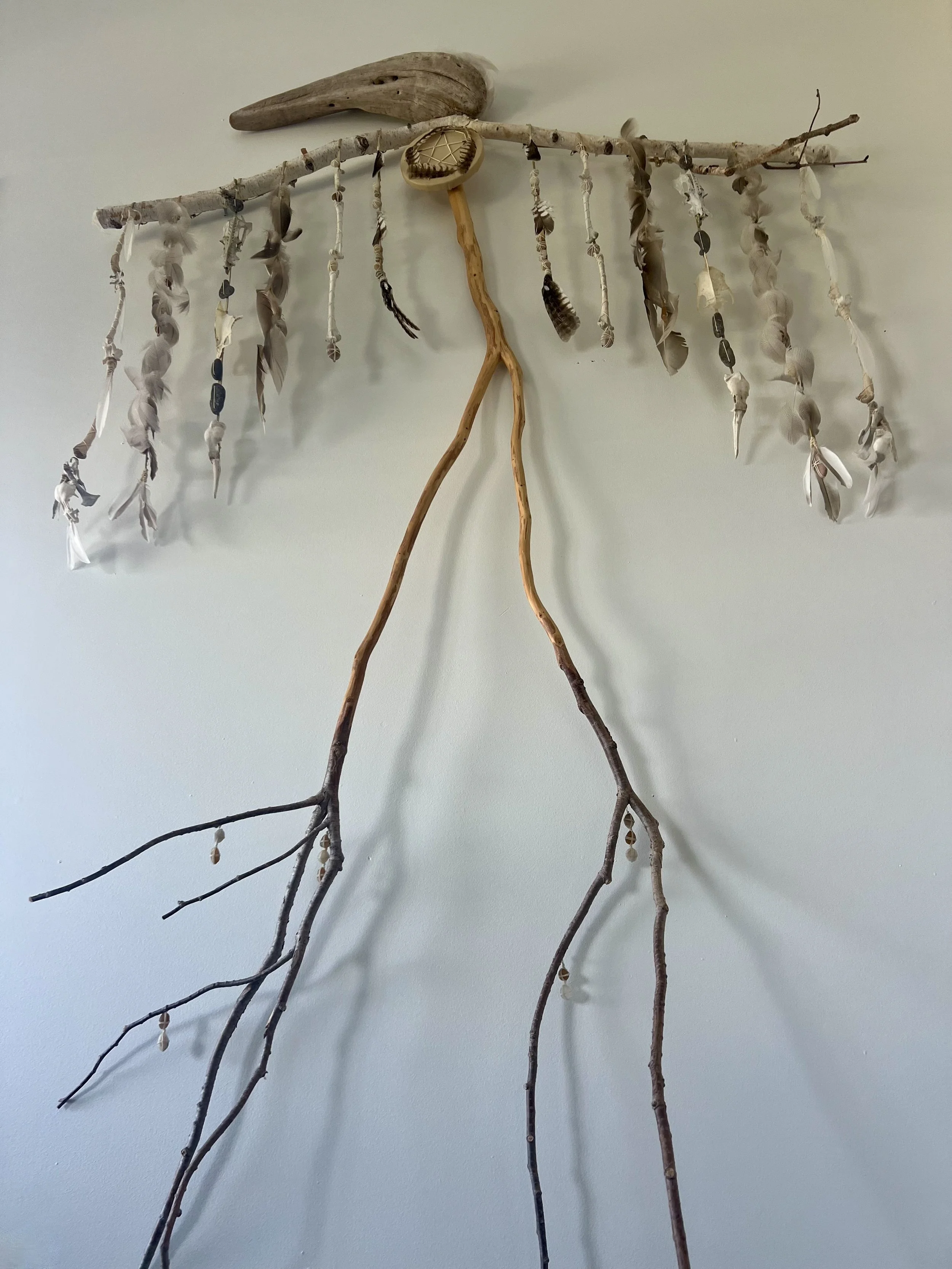
This one was made for me. For the threshold of my own becoming — the crossing that preceded everything else you see here. The head found on the shore of Lake Superior. The wings from the first birds I ever stopped for. The body of cedar from the grove beside my home. Made before I knew what I was doing, or where it would lead. The first large piece. The one that opened the door.
-
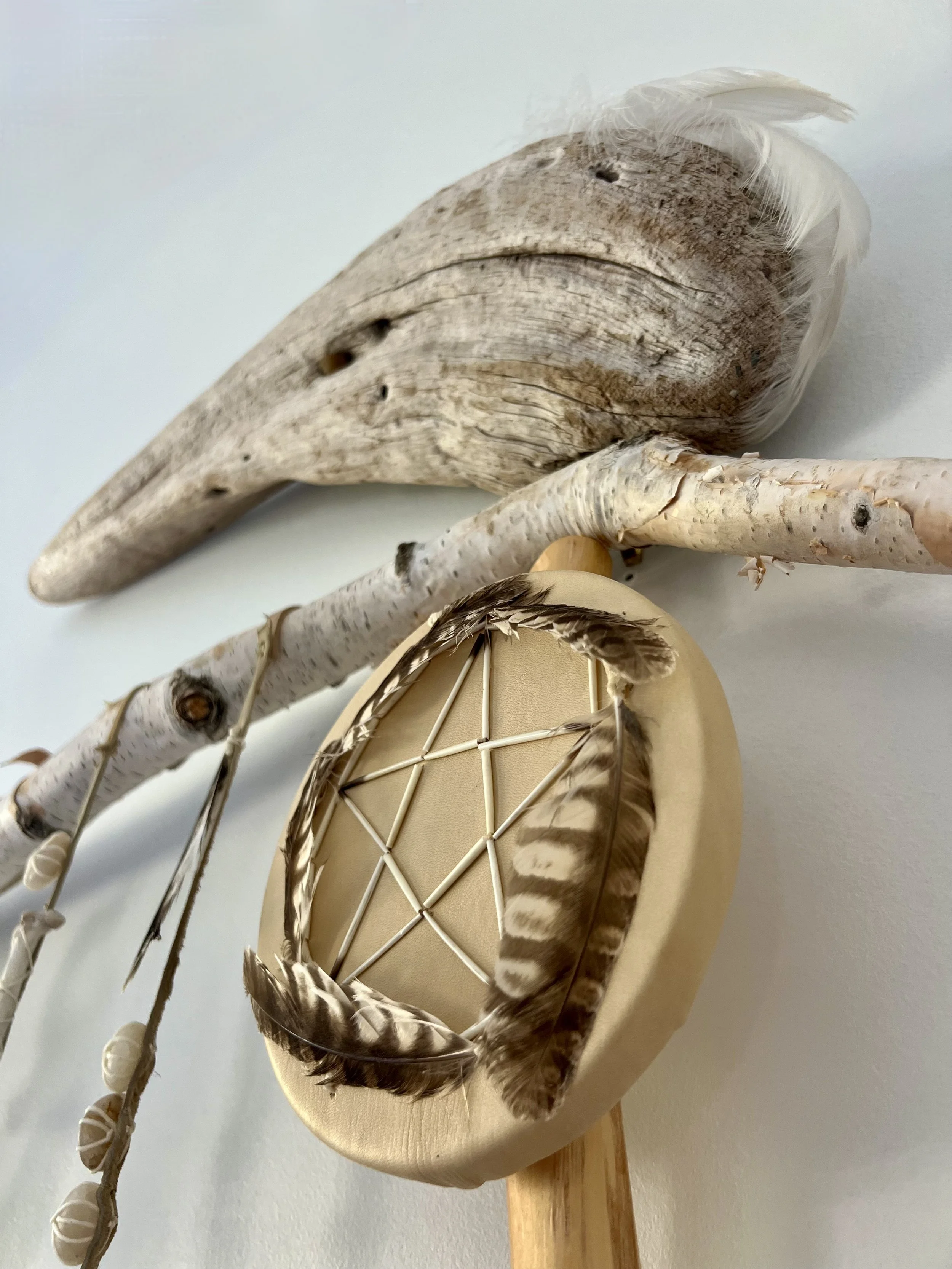
The head, a weathered piece of wood that my son and I found on the shore of that Great Lake Superior. An island rubbing against the chafing boundaries of the reservation system. The Red Cliff nation.
The structure of the wings, a piece of birch my partner brought home for me after that nasty winter ice storm left us without power for a week and so many trees without the pulse of life.
The body and legs of cedar from our backyard, down by the no longer pigeoned shore. Cedar who reminds me that I am here to be with them, with the wild raw, not the four walls up on the hill.
The heart of deerskin, found in a basement bin at the Whetung Ojibwa Centre. Its softness bringing me home to touch. Stitched with porcupine from yet another highway death. We sat up late in the garage, full with its musky smell, unskillfully removing the quills.
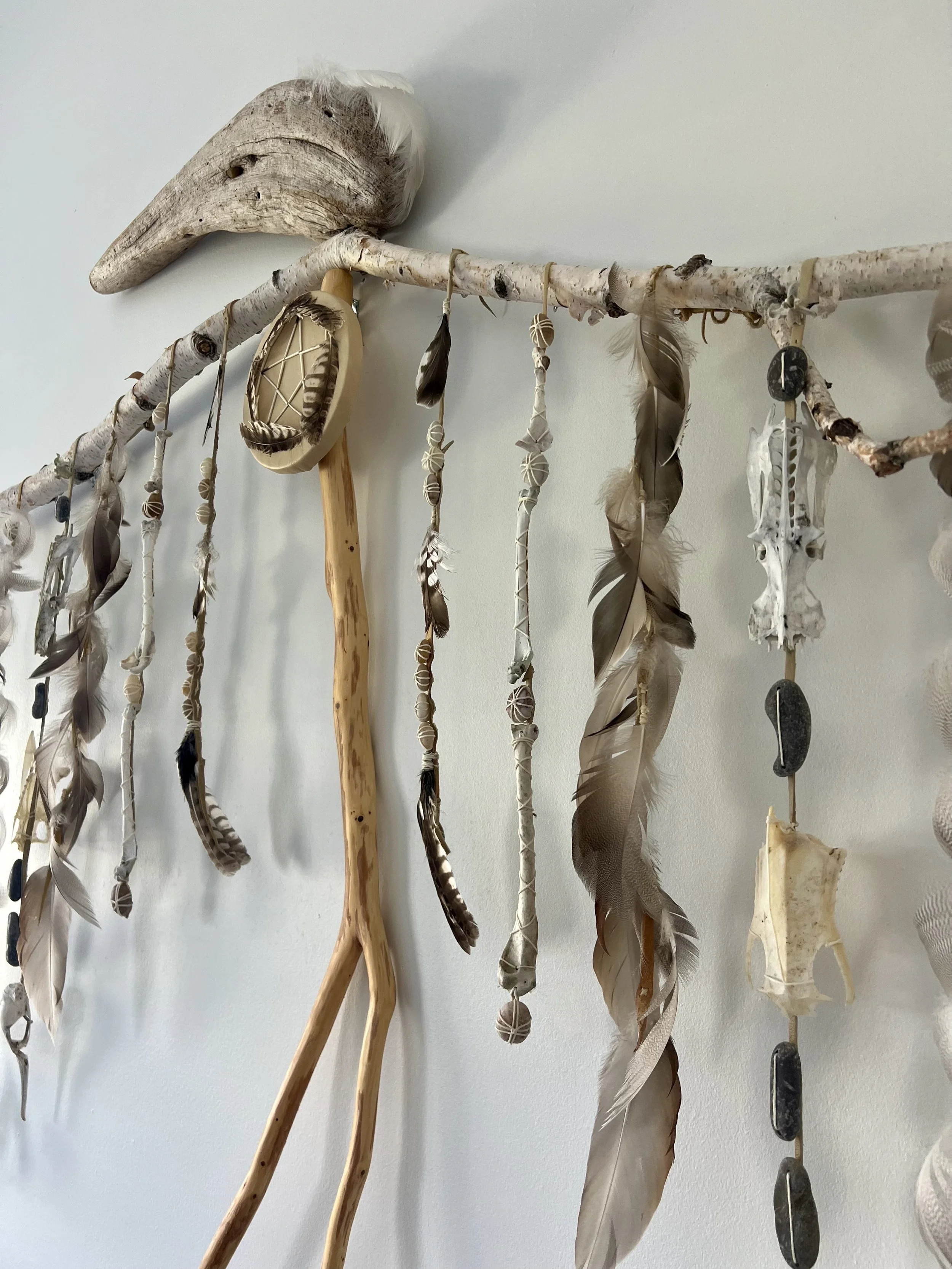
The tendrils of the wings, scraps from another bin. Carrying bones and stones gathered from other shores of these great lakes. Bird skulls, bits of spines, femurs and arms. Plants fossilized in grey stone. Red, amber, yellow and white rocks weighing into life.
Feathers from a mallard duck hit in the small, locked town nearby. My son listening to the kids on the bus who had seen a dead duck. Me telling him I had stopped to pick it up. Only because someone else crossed traffic to move it off the road. I knew it was a gift—a salve for my fear of being seen. I circled back around to lift its lifeless body into my trunk.
The owl feathers from the first bird that I ever stopped to pick up. I shook with adrenaline, nervously and offensively slicing off the wings with my Dad's old switch back blade. Tossing its body into the ditch afterwards, my heart heavy with the knowing that that's not how it's to be done.
The young hawk feathers that fell from a nest. Close to that special place beyond words, painted with the shapes that the deep dark knowing in the blood laps up like molasses. My initials are etched in the stone there, a trespasser laying claim to what was not theirs. Reminding me that I’m an uninvited guest in someone else's home.
The swan feathers gathered from a kayak in the lake out front our house. Not knowing what I was searching for, until their tops of sparkling light appeared floating on the water. They looked like little white canoes nesting in the reeds, blown together by the wind.
It's all up there. Giving one shape of many to this bird. Corvus. Corvus. Corvus. The raven and the crow. The one I saw when she summoned those deeper parts of me. I had no words. Only the feeling of the feathers. An urge to break flight. My neck trying to twist beyond what was in front of me.
This birded me. A self portrait heaving my insides towards a summoned life of creation.
The Line Walker
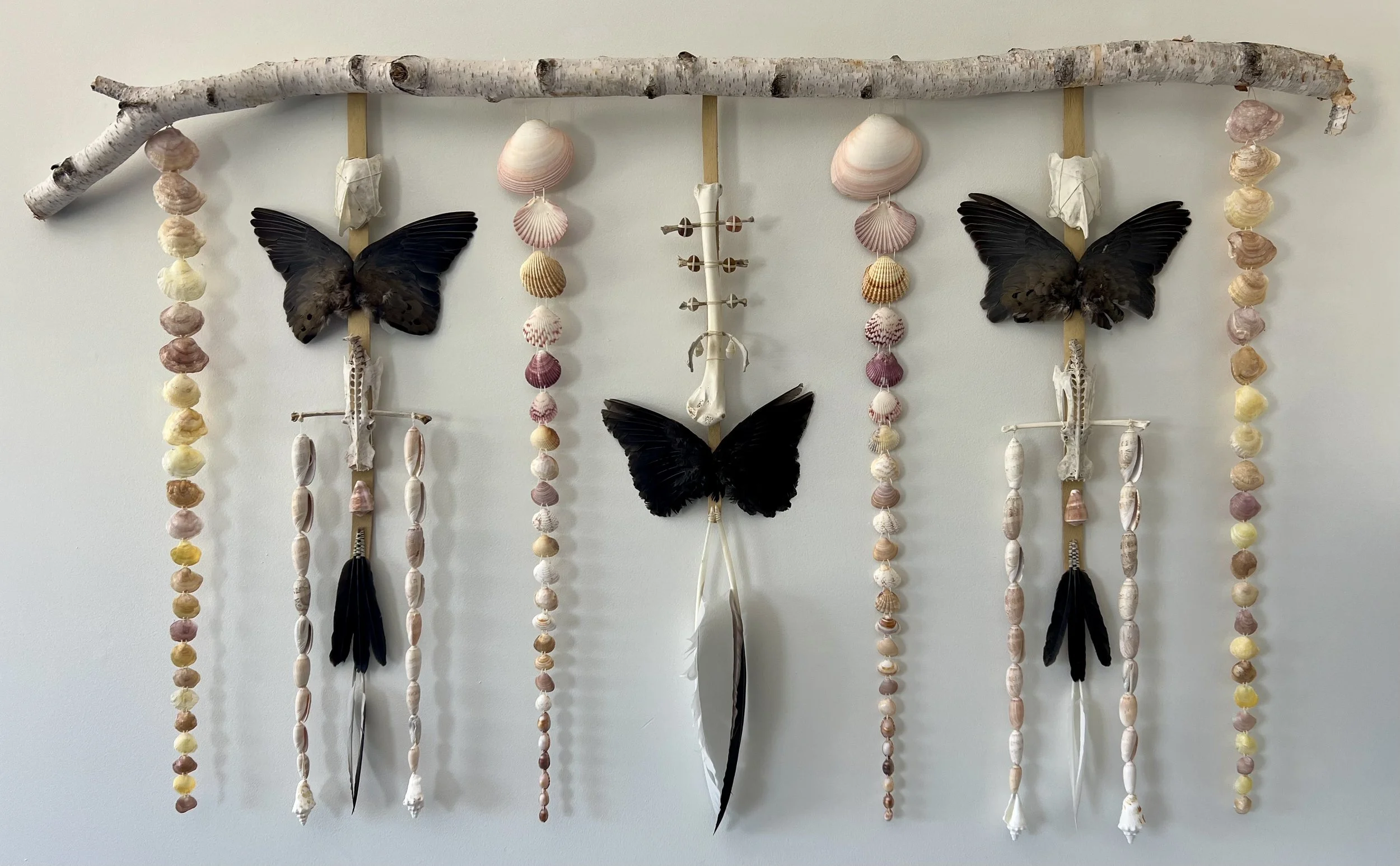
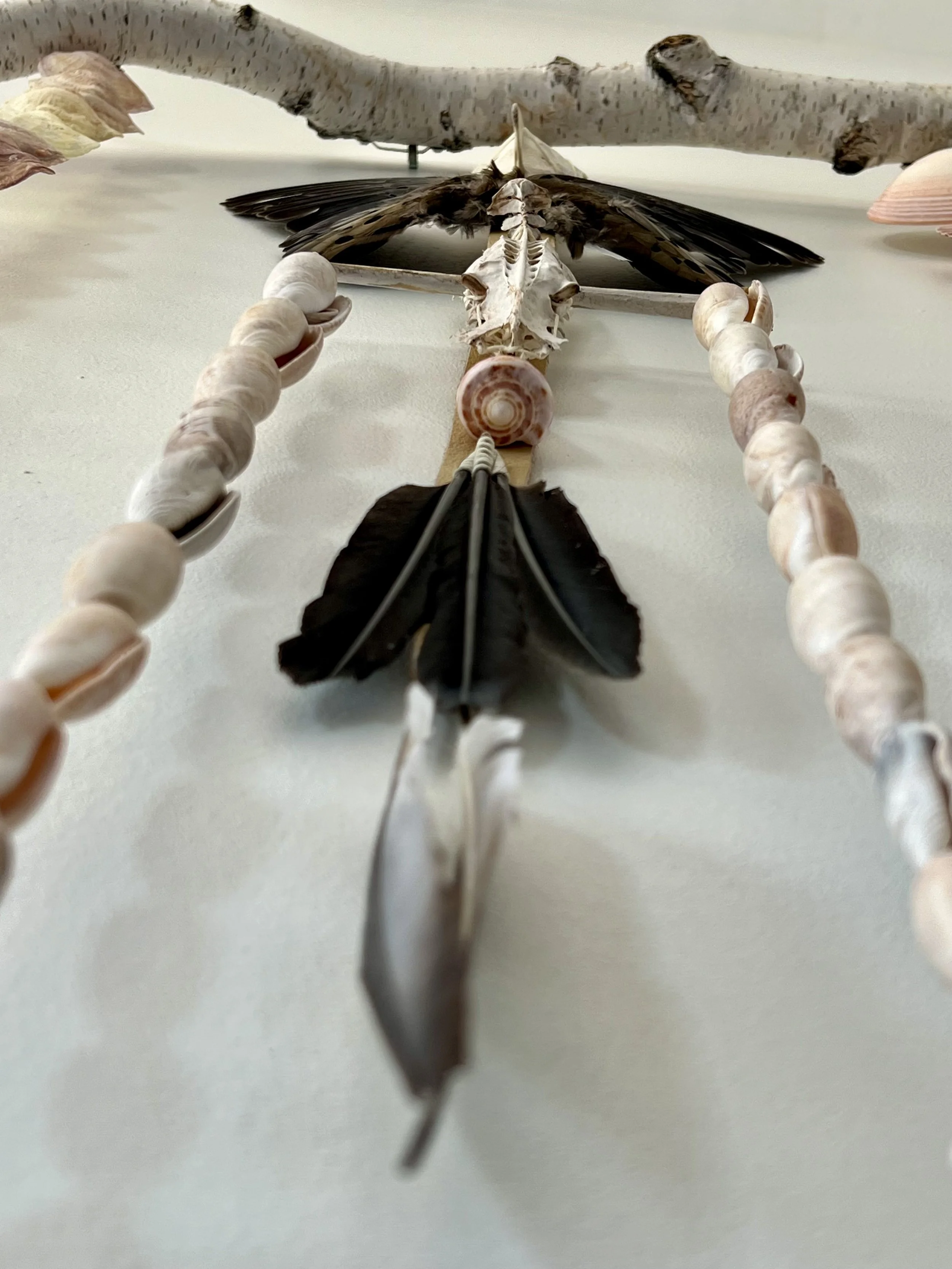
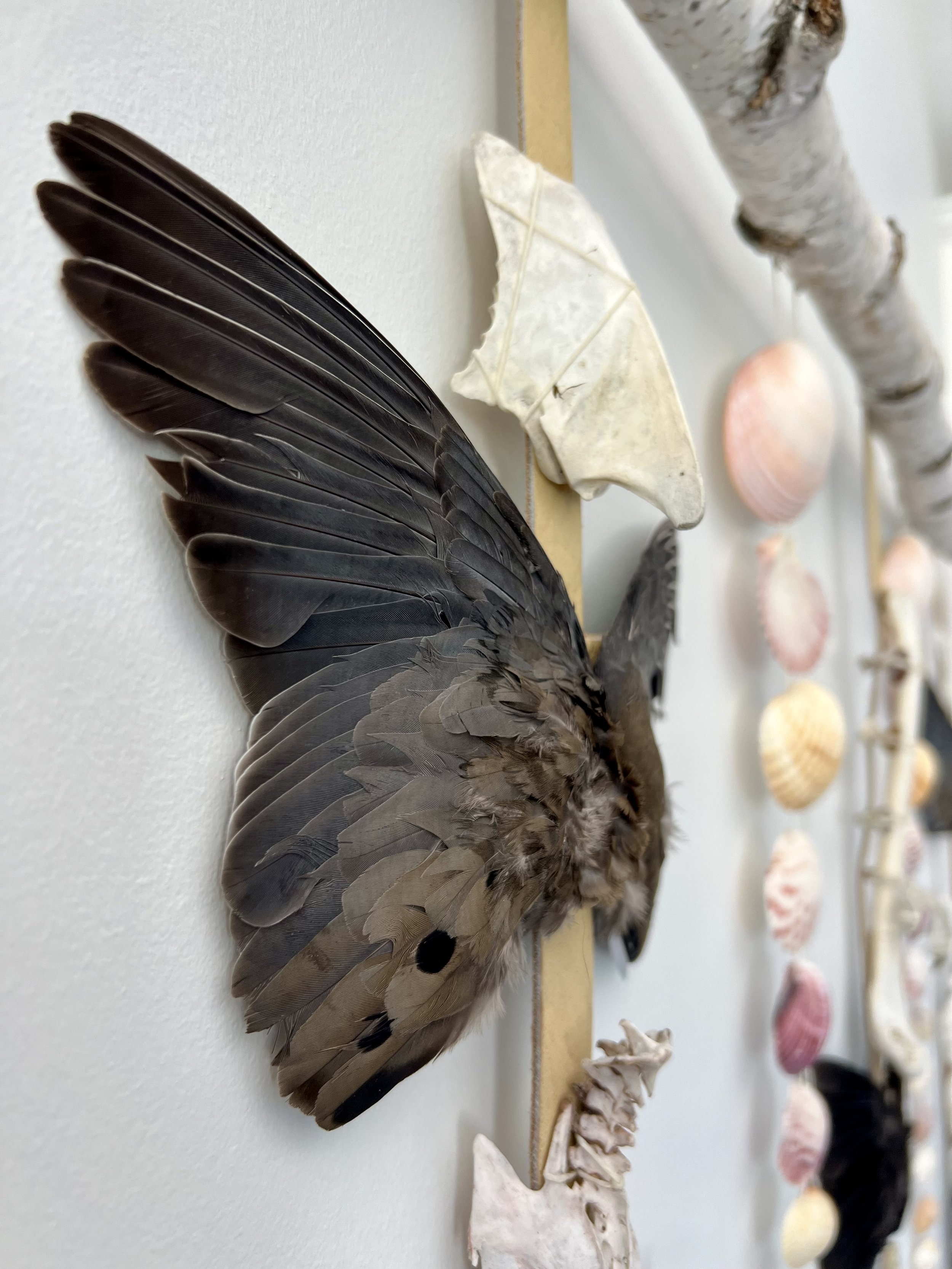
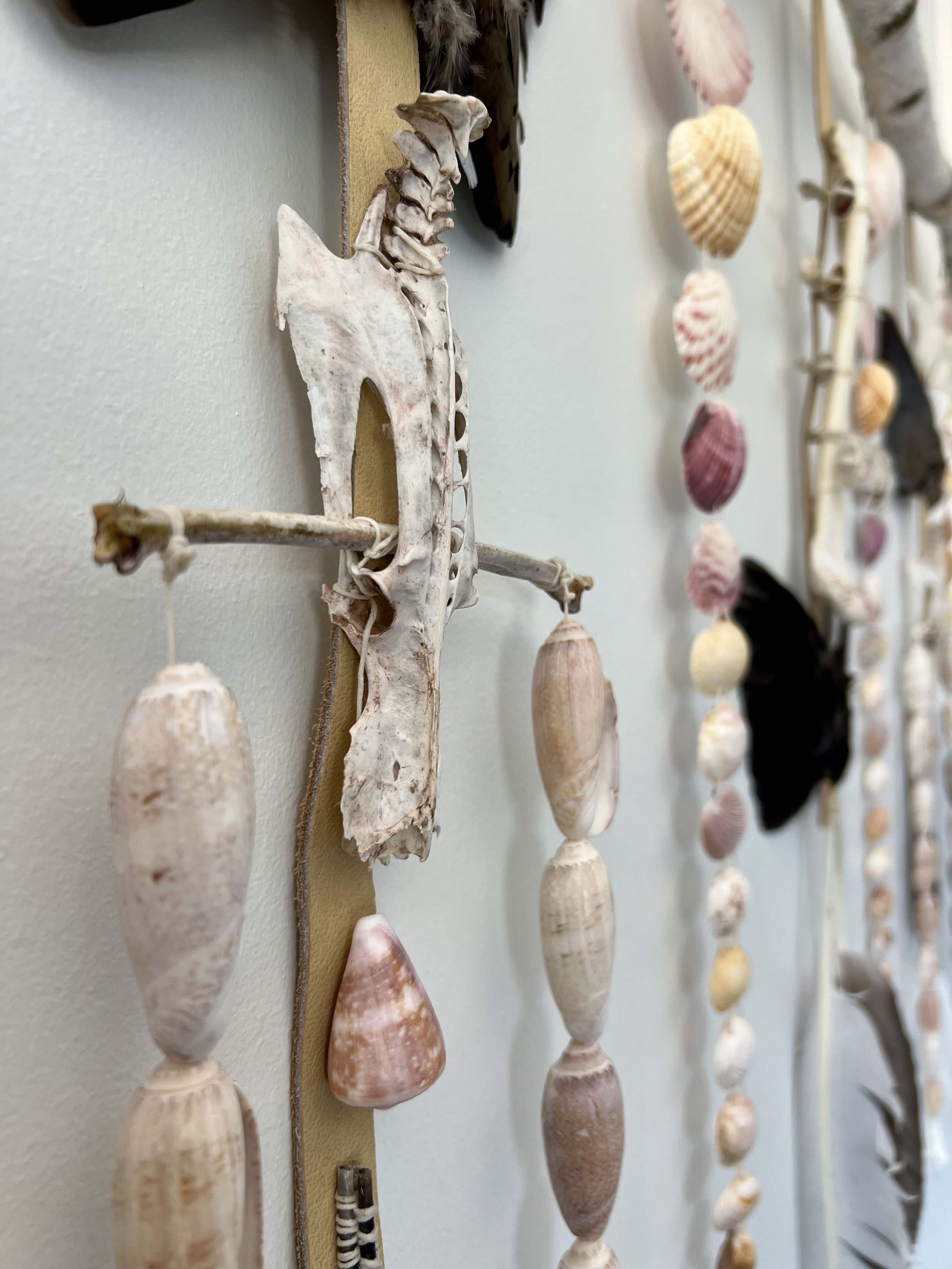
Made for a healer at a threshold of their own. This piece holds the full spectrum — light and shadow, held in balance by the one who walks between them. Wings are central to this piece — as they are becoming central to my work. There is something in them that propels: toward the core of who we are, toward the medicine we carry, toward what's been waiting to be seen.
-
To straddle the in between—that shard of a line hovering in the middle of light and shadow—and to do so with ease. With a delicate touch. A firm tread. A tender knowing. She does not shy away from the ripping and the tearing. From the spinning spiral within the orbit of you. Her body remains perched on that line, so that she may guide you to the parts of you on either side.
The parts drenched with light. Jubilant and loud. Raucously cavorting through a field of daisied treasures. Skipping carefree in your wild as you sing. And the parts bitter in the shadow wounds. Latent with the hurt you didn't even know was there. A twisted knarl of a wail wedged inside of you.
She walks the line. Scaffolded with a mighty spirit. Feather light armor woven all around her. A sparkling eye glistening on either side of the being mile. Watching. Waiting. For whatever may arise. She meets your rage with a roaring rattling scream. Your tiny creaking croak with a soothing soul-filled balm.
She invites you to be both. There in the middle of things. To hold presence in the twisting. To open to the pulse of an ever-shifting spirit. One that can't be contained in singularity. No tiny box or cradle fit to shape you. Instead a kaleidoscope of microscopic pulsing beats. Holding form before ebbing to the next thread of you, in the sticky tidal web of life.
To be multitudes is to live beyond the line. Rooted firmly in the rich, reaching depths of shadow. While spreading wide in the splitting, sparking light. Layers upon layers of one another. Woven together in the carnal fabric of this time and place. An eruption of release when you are finally able to hold it all. Outside of the binding brace of a life others tell you to live.
She walks the line for you. Tethered to its teeter. Balancing the in between. The hooks run deep to keep her placed. Her flesh, dripping, bloody, raw. Furled around the pressing weight of a division she embodies. She’s pushing all of her into the burgeoning of a closing door. Keeping it open just enough for you to squeeze through.
Will you squeeze through? Galloping to the evermore. The playground of creative desire. To build your life anew. While she waits there for the next one. Or the next version of you. Ready to cross the threshold. Again. Ready to break through. Her sacred post carolling around the chords of her laughter. Her tears weeping with the sight of what burns inside of you. Dancing on a thread, so that you don’t have to.
What this work holds
What it means to have something made specifically for you, and what can shift when grief finally has somewhere to live.
Where you might be right now
Something has shifted — and you are at a threshold. One version of your life is ending. The next hasn't fully begun.
Maybe you've lost someone. It might have happened recently — the loss still raw, still without shape. Or it might have been years ago, and you're only now finding your way to it, ready in a way you weren't before. Grief doesn't move on a timeline. It waits until you're ready to meet it.
Or maybe it's your own life that's changing shape — a relationship, a job, an identity, a version of yourself you've outgrown. You're surprised to find that even the changes you wanted carry their own grief, their own weight of what you're leaving behind. You're not broken. But you're not who you were, either. And the version of you that's emerging doesn't have a form yet.
In both cases: you want to honour what was. You want to make room for what's coming. One way to move through this territory is to work with someone who knows it — a wayfinder at the threshold of change. Someone who can hold the grief without needing it to resolve. Someone who can stay open alongside you to what the change is asking, so that there's room for something else to find its way in.
What can shift
You get to stop carrying it alone — and in silence. When something is made specifically for you, something that holds the name and shape of your experience, you don't have to keep it locked inside. You walk past it on your wall and something in you remembers. You remember who you were. You meet who you're becoming. The grief doesn't disappear. But it gets to breathe. It gets to be seen. And in that seeing, something loosens. Something shifts. Slowly, in your own time, you find yourself on the other side of something you didn't know you could move through.
For those navigating life change in particular: the resistance is almost always harder than the thing itself. The avoiding, the not-quite-ready, the sense that naming it will make it heavier. In practice, it tends to go the other way. Sitting down with it — looking at it together, letting it take shape in something handmade — is often a relief. Sometimes surprisingly joyful. Even playful. There is laughter in this work, more often than you might expect. And there is a lightness that comes when something finally has somewhere to live outside of you — when you stop carrying it alone and let it be seen.
And sometimes what's hard is not the grief itself but the in-between — standing in the space between who you were and who you're becoming, holding onto past versions of yourself because the new one isn't fully visible yet. That's not a problem. That's exactly where this work lives. Having someone sit with you in the middle of it — someone who can serve as a mirror, who can see what you're moving toward even when the fog is thick — can help to illuminate what's coming before you can see it clearly yourself.
What makes this different
Every piece is made intuitively and specifically for you — there is no template, no repeating pattern, no version anyone else will ever receive. Materials are ethically gathered and processed by hand: feathers from roadsides, shells from shorelines, bone, quill, stone, wood — each chosen for what it carries, not only how it looks. You can bring your own additions — a feather, a stone, something that belonged to someone you've lost — and they become part of the work. Each piece comes with a story written for you: what the piece holds, how it relates to where you are, and what it might be opening toward. The result is something tangible and alive — art that does something, not just hangs somewhere.
Pieces That Arrive On Their Own
Not all of the work I make begins with a conversation.
Sometimes I am moved to create before I know who it's for. Spirit leads, and I follow — into the materials, into the making, into something I don't fully understand until it's done, and sometimes not even then. I'm given only what I need: that this piece exists, that it carries something specific, and that there is a person for whom it was made. I don't always know who that person is. I only know that when they find it, they will.
These pieces are different from the custom work I make in direct relationship with those I work with. They don't begin with your story — they begin with something I've been given, intuitively and in process, that I can only partially name. They tend toward the ceremonial: objects and regalia for those who carry medicine, who do their own work in the world, who need something that holds and amplifies what they already are. It is, I'll admit, a somewhat unusual way to work. But it is the most honest one I have found.
If you find yourself drawn to one of these pieces — if something in you recognises it, even before you understand why — I'd ask you to sit with that for a moment. Not to analyse it. Just to notice it. And then, if it stays with you, to reach out. We'll talk. You'll know if it's yours.
These pieces are not priced in the conventional sense. If you feel called to one, get in touch and we'll find our way to a conversation about what feels right. What I can tell you is that these are not decorative objects. They are made to be used, held, lived with — by the person they were made for.
A Note on Materials
Every material I work with was once part of something living — or still is.
The feathers and wings come from birds found on roadsides and shorelines — or brought to me by those who know the work I do and save what they find. The bones come from animals that have died in the wild, most gathered from Great Lakes shorelines where they arrive already cleaned by water and time.
The shells come from beaches I've walked across over many years and many places — and from my mother, who spent years sailing and gifted me boxes of shells gathered from Mexico, the Caribbean, Portugal, Spain, and the Mediterranean. Some shells were traded with people at the farmers market who saw the work and brought me bags of their own gatherings in exchange for a piece of jewellery. Materials arrive in many ways. Almost always through relationship.
The wood I work with comes from two places: driftwood from Great Lakes shorelines, and cedar and birch from forests and the grove beside my home. I work only with what has naturally fallen — branches brought down by wind or ice, wood worn loose by water. Last year a major ice storm left us without power for ten days and brought down many trees. Most of what I have worked with since came from that storm.
The hides I use — typically deer and moose — are purchased from the Whetung Ojibwa Centre in Curve Lake, the First Nation closest to my home. It is one of my favourite places to visit. A stunning art gallery, handcrafted works, ceremonial tools, things made with care and intention. One of those places that asks you to slow down. Most of what I cannot gather or make myself I source from there.
The cording I use is the one thing I currently order rather than gather — cotton, hemp, linen, and waxed cord, undyed where I can find it. My intention is to work only with cord that is undyed or dyed with natural methods, and eventually to source it from someone I know and trust, or to learn to make my own. I am always striving to work more relationally with everything I use.
How I process what I gather
When I bring a bird home, I freeze it first — to clear any bacteria or parasites. Singular feathers are then soaked and washed in a solution of water, vinegar, and witch hazel — a natural disinfectant that sanitises and removes odour without damaging the feathers. For whole wings, I carefully remove them from the body, pin them flat, and pack them completely in salt, which draws out remaining moisture and cures them. This takes two to three months. The remaining carcass is either buried in the cedar grove — its bones to be reclaimed after decomposition, which can take two to three years — or left in the forest for scavengers and other animals. Nothing is wasted.
Bones gathered from shorelines I tend to leave as they are — with their algae, their weathering, their particular colours. They come to me already shaped by time and water. That feels right to me. The imperfections are part of what they carry.
Quills are carefully removed one by one, then frozen and washed in the same solution as the feathers.
On the birds
I find a lot of birds. More than seems like coincidence. In one recent month alone: two pheasants, an owl, a mallard, a turkey, a red-winged blackbird, an oriole, a black-billed cuckoo, and a chickadee. Friends and family who know the work save birds for me too — a photograph sent, a bird carefully frozen, waiting until we next see each other. My son, who is eight, helps me spot them from the car. He watches for them on roadsides, encourages me to stop, watches for traffic while I gather. We have talked about the discomfort of it, and he has been a quiet and beautiful encouragement.
Finding them feels like a gift. It feels sacred. And it feels like a responsibility — to honour what they were, to work carefully and intentionally, and to keep going. Each one carries both grief and something else. The sorrow of a life ended, and the possibility of what that life can still become — held in a piece made for someone else's grief, their own crossing, their own threshold.
On gathering
Gathering is not collecting. When I stop for something on the side of the road, I'm not acquiring a material. I'm entering into a relationship with what that creature was, and with what it can still be. I ask, internally, whether their spirit would like to collaborate. Sometimes the answer is no. When it's yes, I bring it home carefully.
Ethical gathering means different things to different people. For me it means taking only what I'm given. Asking. Processing with care. Not wasting. Knowing the difference between a material that wants to be used and one that needs to be left alone.
If you'd like to understand more about what this looks like in practice — including the moments I got it wrong and what I learned — you can read more in Mistakes and What I've Learned.